AI Class 10 Concepts of Modelling Questions (CBSE 417) are designed to help students understand and practice Modelling. Based on the CBSE curriculum, these questions cover problem scoping, data acquisition, data exploration, modeling, and evaluation, helping students strengthen concepts and perform well in examinations.
Study Advanced Concepts in Modelling here before practising the Questions
MCQ’s
1. Which of the following is an example of supervised learning?
- Clustering animals into groups
- Spam email classification
- Discovering shopping patterns
- Grouping news articles
Answer
Spam email classification
2. What type of data does supervised learning use?
- Unlabelled
- Random
- Labelled
- Mixed
Answer
Labelled
3. Which model works on the principle of reward and punishment?
- Supervised Learning
- Unsupervised Learning
- Classification
- Reinforcement Learning
Answer
Reinforcement Learning
4. Which sub-field of AI mimics the human brain structure?
- Artificial Neural Networks
- Convolutional Networks
- Decision Trees
- Rule-based Systems
Answer
Artificial Neural Networks
5. What does ANN stand for?
- Artificial Nerve Network
- Automated Neural Network
- Artificial Neural Network
- Adaptive Node Network
Answer
Artificial Neural Network
6. Which type of learning is used when we do not know the output?
- Supervised
- Unsupervised
- Reinforcement
- Logical
Answer
Unsupervised
7. Which of the following is not an application of machine learning and deep learning?
- Digit recognition
- Face detection
- Spam email classification
- Rule-based chat
Answer
Rule-based chat
8. What does the input layer in a neural network do?
- Feed data into the network
- Connect output nodes
- Process information
- Decide final result
Answer
Feed data into the network
9. Which AI model uses fixed rules to make decisions?
- Reinforcement model
- Learning-based model
- Rule-based model
- Regression model
Answer
Rule-based model
10. Which of the following is a feature in a dataset?
- Labels only
- Column attributes
- Output values
- Predefined answers
Answer
Column attributes
11. Which learning type is most suitable for anomaly detection?
- Unsupervised
- Reinforcement
- Supervised
- Regression
Answer
Unsupervised
12. Which of the following is a classification problem?
- Predicting stock prices
- Grouping books by genre
- Estimating house prices
- Predicting whether a customer will buy a product or not
Answer
Predicting whether a customer will buy a product or not
13. In reinforcement learning, what happens when the agent performs incorrectly?
- It is terminated
- It is rewarded
- It is penalized
- It resets
Answer
It is penalized
14. Deep learning is best applied in which scenario?
- Large image datasets
- Structured tabular data
- Small dataset
- Binary classification
Answer
Large image datasets
15. Which of the following best describes a regression model?
- Classifies data into clusters
- Predicts continuous values
- Finds associations
- Uses feedback for learning
Answer
Predicts continuous values
16. Which learning model would you choose for a stock price prediction system?
- Clustering
- Classification
- Regression
- Association
Answer
Regression
17. Which of the following is valid according to Neural Networks?
- Neural Network contain 4 layers (input, processing, hidden and output layers)
- In Neural Networks every node is essentially a machine learning algorithm.
- Use the Neural Network if the dataset is small only.
- The input layers processes the data with algorithms and supply to next layer.
Answer
In Neural Networks every node is essentially a machine learning algorithm.
18. What differentiates reinforcement learning from supervised learning?
- Uses labelled data
- Uses reward-based feedback
- Works only with images
- Is used for classification
Answer
Uses reward-based feedback
19. Which layer of a neural network performs most of the computation?
- Input layer
- Output layer
- Hidden layer
- Bias layer
Answer
Hidden layer
20. In neural networks, what are weights and biases used for?
- Visualizing features
- Scaling output
- Adjusting influence of input nodes
- Measuring data size
Answer
Adjusting influence of input nodes
21. In association models, what kind of insight is generated?
- Labels
- Predictions
- Relations between variables
- Probabilities
Answer
Relations between variables
22. A smart assistant recommends songs based on listening history. Which type of learning is it using?
- Supervised
- Unsupervised
- Reinforcement
- Regression
Answer
Unsupervised
23. A company wants to forecast next quarter’s revenue. Which model should they use?
- Classification
- Regression
- Clustering
- Reinforcement
Answer
Regression
24. An AI robot improves its performance by navigating a maze through repeated tries. What learning type is this?
- Supervised
- Unsupervised
- Reinforcement
- Regression
Answer
Reinforcement
25. A retail store wants to understand which products are frequently bought together. Which model fits?
- Classification
- Regression
- Clustering
- Association
Answer
Association
26. An app filters spam messages using a pre-trained dataset. What learning approach does it use?
- Supervised
- Unsupervised
- Reinforcement
- Association
Answer
Supervised
27. What is the main purpose of the bias in a perceptron model?
- To increase the number of input features
- To adjust the learning rate
- To shift the decision boundary
- To reduce overfitting
Answer
To shift the decision boundary
28. Which of the following is a real world application of Neural Networks?
- Facial Recognition
- Customer support Smart bot
- Weather forecast analysis
- All the above
Answer
All the above
29. Which of the following statements best describes a perceptron?
- A simple neural network that performs linear classification.
- A non-linear machine learning model used for complex tasks.
- A complex deep learning network with multiple hidden layers.
- A type of reinforcement learning algorithm.
Answer
A simple neural network that performs linear classification.
30. The perceptron algorithm can only solve which type of problems?
- Non-linear classification
- Multi-class regression
- Linearly separable classification
- Time-series forecasting
Answer
Linearly separable classification
Assertion & Reasoning
31. Assertion (A): Supervised learning uses labelled data to train AI models. Reason (R): Labels help the model understand the correct output for each input.
- Both A and R are true and R is the correct explanation of A
- Both A and R are true but R is not the correct explanation of A
- A is true but R is false
- A is false but R is true
Answer
Both A and R are true and R is the correct explanation of A
32. Assertion (A): Unsupervised learning can identify hidden patterns in data. Reason (R): Unsupervised learning requires data that is already labelled for classification.
- Both A and R are true and R is the correct explanation of A
- Both A and R are true but R is not the correct explanation of A
- A is true but R is false
- A is false but R is true
Answer
A is true but R is false
33. Assertion (A): Neural Networks have multiple layers for processing information. Reason (R): The hidden layers of a neural network help the machine perform calculations and learn patterns.
- Both A and R are true and R is the correct explanation of A
- Both A and R are true but R is not the correct explanation of A
- A is true but R is false
- A is false but R is true
Answer
Both A and R are true and R is the correct explanation of A
34. Assertion (A): Reinforcement learning works without labeled data. Reason (R): The model learns by receiving feedback from its actions.
- Both A and R are true and R is the correct explanation of A
- Both A and R are true but R is not the correct explanation of A
- A is true but R is false
- A is false but R is true
Answer
Both A and R are true and R is the correct explanation of A
35. Assertion (A): Regression models are used when output is a category like spam or not spam. Reason (R): Regression works with continuous numerical values, not categories.
- Both A and R are true and R is the correct explanation of A
- Both A and R are true but R is not the correct explanation of A
- A is true but R is false
- A is false but R is true
Answer
A is false but R is true
Short Answer Questiosn (SAQ’s)
1. Define Machine Learning (ML) with examples.
Answer
Machine Learning enables machines to learn from data and improve from experience.
Examples: Object Classification, predicting house prices, predicting temperature, Predicting stock prices, Anomaly detection in emails.
2. Write a difference between Training Data and Testing Data.
Answer
Training Data
Training dataset is a collection of samples given to the model to analyse and learn.
Testing Data
Testing data is a collection of samples given to the model to test its accuracy.
3. Give two real-life examples of reinforcement learning.
Answer
a. An AI playing a video game and improving by receiving rewards and penalties.
b. A Self driving car trying to park in empty parking slot.
4. What is an Artificial Neural Network (ANN)?
Answer
ANN is a computing system inspired by the human brain, consisting of layers of interconnected nodes that process data and learn patterns. Each Node in ANN acts as a Machine learning algorithm.
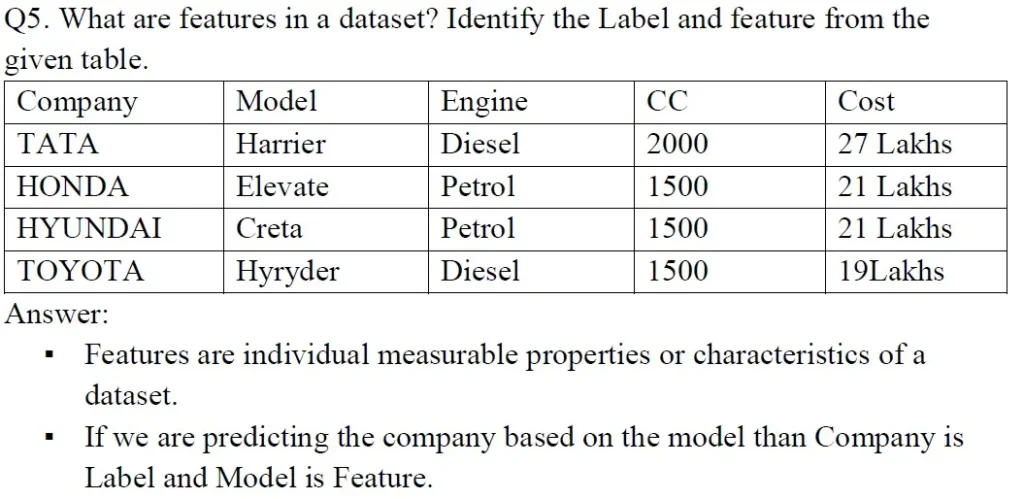
5. What are features in a dataset? Identify the Label and feature from the given table.
Answer
Features are individual measurable properties or characteristics of a dataset.
If we are predicting the company based on the model than Company is Label and Model is Feature.
6. A social media app tags your friends in photos using previously tagged data. Identify the learning type and justify.
Answer
It is Supervised Learning because the model uses labelled (tagged) data to make predictions.
7. How is a rule-based AI model different from a learning-based model
Answer
Rule-based model
A rule-based model follows predefined rules and does not adapt/change.
Data and Rules are supplied to Rule based model gives results/answers.
Learning-based model
A learning-based model learns from data and can adapt to changes.
Data and Results/answers are supplied to Learning based model gives rules (patterns to understand data).
8. An autonomous vehicle is learning to navigate through a city and receives rewards for safe driving and penalties for violations. a) What kind of learning is being implemented? b) How does this method help the AI system learn to perform the task better over time?
Answer
a) Reinforcement Learning
b) Reinforcement learning helps the AI agent learn through trial and error. It gets feedback in the form of rewards or penalties. Over time, the system optimizes its actions to maximize positive outcomes, making better decisions in similar situations in the future.
9. You are building a model to group customers based on buying habits without prior labels. Which learning type will you use? Why?
Answer
Unsupervised Learning approach, because it finds hidden patterns, trends in the unlabelled data.
10. Differentiate between classification and regression models.
Answer
Classification
This model deals with discrete outputs which means the data need not be continuous. Example: spam or not spam, Sunny, Cloudy, Rainy.
Regression
This model works on continuous data. Example: predicting temperature or house price.
11. A healthcare provider wants to identify patterns in patient data to personalize treatment plans. They have a dataset with various patient attributes but no predefined labels indicating specific treatment plans. a) What type of learning approach is being used here? b) Explain how this approach helps in deriving insights from the dataset.
Answer
a) Unsupervised Learning
b) In unsupervised learning, the system works with unlabelled data. It identifies patterns, similarities, and differences on its own. In this case, the machine clusters patients based on shared characteristics, which can lead to grouped treatment plans for patients with similar profiles.
12. How can a regression model help predict real estate prices?
Answer
Regression model works on continuous data. (numeric data) It uses features like size, location, and number of bedrooms to estimate a house’s price as a continuous output.
13. What are the differences between Clustering and Classification
Answer
Clustering
Clustering finds similarities between objects and places them in one cluster and objects with other similarities in another cluster.
Example: Recommendation systems in OTT Platforms.
Classification
Classification uses predefined classes in which objects are assigned.
Example: Email is Spam or not, Weather Forecast.
14. If a machine identifies similar songs based on listening habits, which model and method is being used? Identify the Learning approach and Model.
Answer
Unsupervised learning approach.
Clustering model.
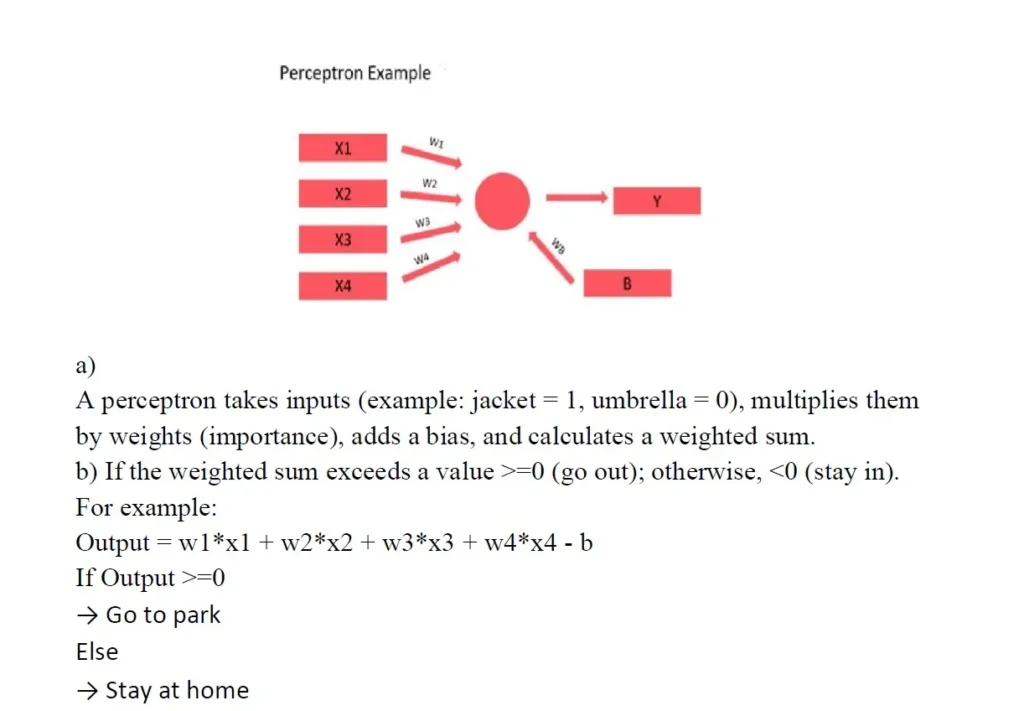
15. You are asked to represent the decision-making process of going out to a park based on four conditions: having a jacket, having an umbrella, current weather, and weather forecast. a) Explain how a Perceptron model works in this context. b) Illustrate the concept of weights, bias, and threshold in making the decision.
Answer
a) A perceptron takes inputs (example: jacket = 1, umbrella = 0), multiplies them by weights (importance), adds a bias, and calculates a weighted sum.
b) If the weighted sum exceeds a value ≥ 0 (go out); otherwise, < 0 (stay in). For example: Output = w1*x1 + w2*x2 + w3*x3 + w4*x4 – b. If Output ≥ 0 → Go to park, Else → Stay at home.
Long Answer Questiosn (LAQ’s)
Source: KVS ZIET MYSORE AI SSM(417) 2025-26