
Modern tech is making our lives easier.
Remember when we used to copy each other’s homework in school? Manual writing used to take us a lot of time.
But that is not the case in professional life anymore.
We can just use Optical Character Recognition (OCR) technology to do that for us in seconds.
Just click an image of whatever you want to copy and paste it into an image-to-text converter. Your text will be ready to copy and paste in a few seconds.
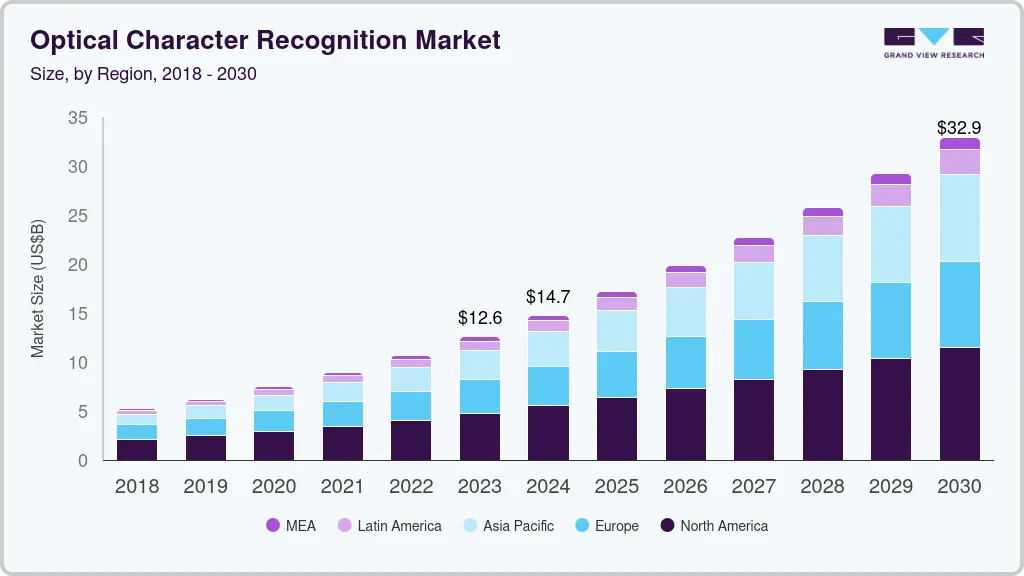
This technology is so popular these days that the OCR market is expected to grow from $10.62 billion in 2022 to 32.90 billion by 2030.

Source: Grand View Research
And why not! It’s one of those innovations that saves us hours of typing. In fact, connecting the real and digital worlds is easier than ever before.
What is OCR technology?
OCR, or Optical Character Recognition, reads printed or handwritten characters from images or scanned documents. Then converts them into machine-readable text.
In simpler terms, it lets your computer “see” text in images and “understand” it.
It works in apps like Google Lens, Adobe Scan, and image-to-text converters (like imagetotext.online).
Just upload a photo, and it instantly turns any visible text into editable form.
How image to text conversion works
OCR technology uses advanced algorithms and AI to recognize characters.
The process typically goes in the following four steps:
1. Image preprocessing: The algorithms adjust the brightness and contrast of the image for a better scan.
2. Text detection: The System identifies the regions of the image that contain text.
3. Character recognition: The OCR engine reads and matches each character with the characters in its database using trained AI models.
4. Output generation: Finally, it converts the recognized text into an editable format like Word, PDF, or plain text.
Each step is performed in a fraction of a second, and results are given as soon as you click “Convert.”
This makes OCR fast and accurate for both businesses and individuals.
How image to text conversion shapes modern tech
OCR has changed how we handle information in 2025.
It bridges the gap between printed material and digital storage. It has become easier to process, analyze, and share data now.
It’s a major player in automation, accessibility, and AI-driven analytics.
1. Saves time by reducing manual data entry
With OCR, data entry has become faster than ever.
Take a multi-center ICU study, for example. Researchers used an OCR-based data entry system to cut the average manual entry time for patient device data from 6.0 minutes to 3.4 minutes per record.

This difference helps businesses process invoices, receipts, and reports regularly. This means less time typing, more time doing real work.
2. Improves accuracy and minimizes errors
When typing manually, we can make mistakes and typos. But not with OCR technology (if it successfully detects every word).
This accuracy is very important in business communications and record-keeping. Like in the above example of patient data. A single typo or error can cause trouble.
A very famous example of that is from 1995. When a patient, Willie King, was brought in for surgery to remove his right leg due to diabetes.
But unfortunately, someone mistakenly wrote “left leg” in the records. Surgeons amputated the wrong leg and realized their mistake after the surgery was complete.
They had to do it all over again. And the patient lost both his legs.
If they had OCR at that time, this mistake could have been avoided.
3. Boosts accessibility for everyone
OCR technology helps more people access knowledge.
For example, not everyone can afford to buy books and research papers in hard form. If we upload them online using tools that convert pictures into words, more people will be able to read them.
You do not have to do much. Just click photos from your phone and paste them to imagetotext.online all at once. Yes, it can take multiple images at a time.
And in multiple formats too, such as JPG, WEBP, GIF, PNG, TIFF, and BMP. Then you just have to click “Convert.” The image to text tool will take care of the rest.

And if you can combine this OCR with a text-to-speech (TTS) tool, we can further improve accessibility to visually challenged users.
4. Supports digital transformation and eco-friendly practices
Companies are going paperless to save trees. And OCR helps in that.
With this technology, paper contracts, printed trade records, or forms can be scanned and stored as searchable digital text.

Source: Facebook

This reduces physical storage needs and lowers paper use. Plus, if your content is in soft form, say a PDF, you can ask questions on it. The paragraph-generator.com has a tool exactly for that.
You just need to paste it in the Chat PDF free tool and it will be able to answer any relevant question.

In addition, extracting text via image-to-text helps with saving business records digitally, improving retrieval speed, and security.
5. Enhances productivity and workflow automation
OCR is now being used in workflows to automatically extract data. It is fed into systems without human touch.
For example, real-time data extraction has reduced expense management time by 65%.
In the ICU study I mentioned before, not only was data entry faster, but accuracy stayed high (~96.9%). Plus, users rated the system as highly easy and useful.
All this frees up your time for creative, strategic tasks. Reducing your manual efforts.
Conclusion
OCR is an innovation that drives modern digital workflows.
It saves us hours of manual data entry and is also eco-friendly. Exactly how modern workflows should operate.
It is being used in hospitals, offices, and everyday apps. Image-to-text conversion helps professionals everywhere work smarter, faster, and with fewer errors.
So, whether you’re a student, marketer, or business owner, it’s the right time to explore how OCR can simplify your daily tasks.