
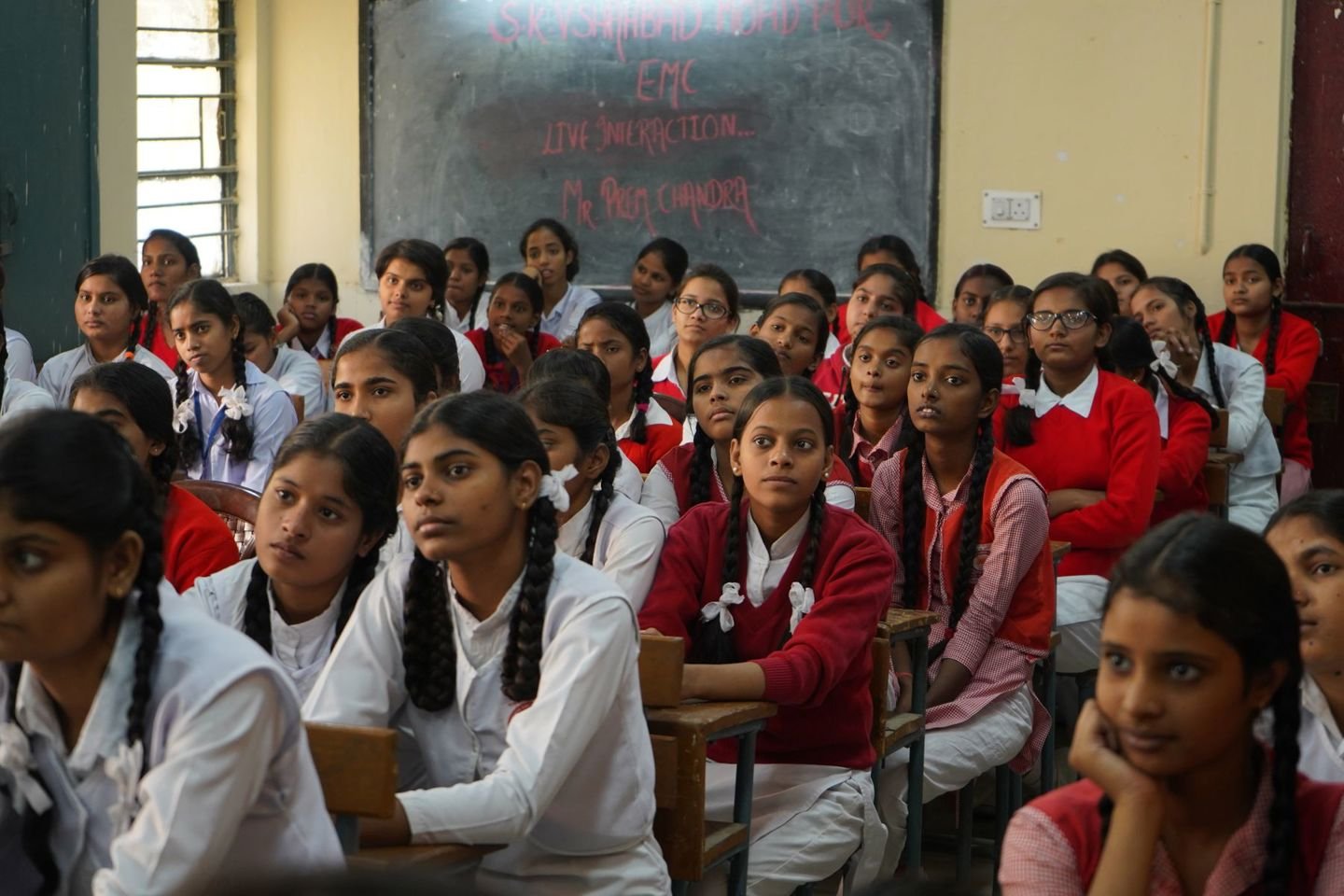
As a disruptor of many industries, it is only a matter of time until blockchain technology starts seeing use in schools, colleges and universities in India. Some initial use cases could be how qualifications are issued, student achievements are verified, and academic records are shared. It might be odd to consider blockchain in this light, considering that, for the most part, people think about blockchain in terms of the digital assets that are tracked by the Bitcoin INR price on exchanges like Binance, but the applications of blockchain are diversifying far beyond the bounds of speculative trading on digital assets.
Of particular relevance in the case of education, blockchain technology can be used for secure data exchange, credential verification and the running of educational administrative tasks. The education system in India provides a better environment than many others for the testing of these sorts of applications.
Reports from 2023-24 by the Ministry of Education’s Unified District Information System for Education Plus (UDISE+) covered an enormous 14.72 lakh schools, 98 lakh teachers and 24.8 crore students. This is an astounding amount of records to gather and manage. The simple act of verifying credentials, authenticating certificates and managing the transfer of student information to different institutions becomes complex in such an enormously data-rich environment. Blockchain technology could help to simplify and ease some of the friction associated with this environment.
How Can Blockchain Improve Academic Record Management?
Blockchain can improve academic record management by providing a tamper-proof, shared record of academic achievements and certifications. This would make it much simpler for student credentials to be checked by different institutions, and would save schools, colleges and universities from needing to maintain their own dedicated in-house records. An institution would simply issue a digitally signed credential, which would allow other institutions in the future to check its authenticity via a blockchain-based record system.
This would make life much simpler for Indian students as they progress through the education system and want to apply for university courses, postgraduate degrees or even when they are applying for jobs for which their education history is relevant. There would be no need for a lengthy exchange between institutions, nor for physical paperwork to be filled out; institutions would simply need to use a digital system to verify the authenticity of a student’s digital credentials.
It is important to note that while blockchain technology could provide a tamper-proof record system, it is not infallible. There would still need to be checks placed on the issuing institutions to ensure that the credentials they are awarding are legitimate, and mistakes could still occur in legitimately issued credentials.
Could Blockchain Make it Easier for Qualifications in India to be Verified?
Yes. Using a blockchain-based system for qualification verification would simplify the process of checking professional certificates, academic transcripts and degrees. The theory is that a student could hold the details of a digitally signed certificate and issue permission for employers or other relevant parties to view and verify it when needed.
India is no stranger to digital tracking of academic records and certifications. The Academic Bank of Credits (ABC) already provides Indian students with the ability to accumulate and transfer academic credits while studying, and the National Academic Depository (NAD) facilitates the digital verification and storage of academic awards.
Clearly, there is space in India for such systems, and blockchain technology could be used to improve them. Instead of replacing the existing systems with an entirely new blockchain-based system, blockchain technology can be used merely as the verification method. The proof of the certificate could be stored as a cryptographic blockchain record, while the actual personal information and full document are stored elsewhere in a more protected and private database.
How Could Blockchain Support Personalised Learning?
Blockchain could be used by students to increase the portability of records associated with skills, achievements and courses. The scope of such record-keeping could include formal degrees, vocational training modules, microcredentials and other short courses provided by online tutors.
Such learning records would make it simpler to demonstrate competency or proficiency in a field without needing to drag a large sheaf of paperwork around. Especially in roles or situations where more than one qualification is needed, removing the need to juggle multiple paper certificates will be a significant boon for many students.
Could Blockchain Make Education More Transparent?
Yes, blockchain could make it easier for students and employers to track exactly where academic records come from. Because of the way that blockchain works, a number of different actions would be traceable, such as the issuance of certificates and any changes made to records.
This means that it would be a simple matter for a university to check which institutions previously issued a student with qualifications and to verify the integrity of those institutions.
But any transparency systems would need checks and balances in them to ensure that private sensitive information is not easily accessible or publicly displayed.
Frequently Asked Questions
How Can Blockchain Help Students in India?
By providing a simpler method for the verification and storage of academic records.
Is Blockchain Safe for Storing Student Records?
Yes, if the system for storing those records is designed correctly. It is entirely possible for any sensitive personal information to be stored in such a way that it is not accessible, and that only the relevant educational information would be provided when those academic records are checked.
Will Blockchain Replace Teachers or School Databases?
Absolutely not. Blockchain systems do not provide any functionality for teaching; they are only useful for supporting administrative processes around education, not for undertaking the actual education itself. Schools are likely to need their own databases as well, or access to a shared database system.
Author: Liam Clarke
Liam is a content writer from Australia. He has been writing content for years and has a flexible style that allows him to write content to suit many topics. When he isn’t writing content, he’s watching classic films and providing enrichment for his cat.