
There is a moment that every researcher knows well. It is the quiet panic that sets in just before hitting the submit button on a manuscript. You have checked the arguments, refined the language, and formatted the figures. But there is always that nagging doubt about the references. Did you copy that DOI correctly? Is that obscure conference paper actually from 2018 or was it 2019? And with the rise of AI writing tools, a more unsettling question emerges: did an assistant generate a reference that looks real but does not exist? This anxiety is not unfounded. Over 2,000,000 citations have been put to the test by more than 30,000 scholars across 200 institutions, and the results reveal a landscape where errors are the norm, not the exception. This is why a reliable Citation Checker has become the quiet workhorse of modern academic writing, not as a luxury, but as a fundamental step in the production of trustworthy research.
The Workflow Problem That Nobody Talks About
The academic writing process is fragmented. You draft in a word processor, manage references in a separate tool, and format according to a style guide that seems to change with every submission. Verification, if it happens at all, is usually an afterthought, squeezed in during the final frantic hours before a deadline.
The Cognitive Load of Manual Checking
Manual citation verification is a task that demands high attention but offers low intellectual reward. It involves copying each reference, pasting it into a search engine or library catalogue, and comparing the results against your entry. For a paper with fifty references, this can take an hour or more. For a dissertation with two hundred, it becomes a full day’s work. The cognitive load is substantial, and the likelihood of making a mistake increases with fatigue. This is a poor use of a researcher’s time and mental energy.
The False Sense of Security
Many researchers rely on reference managers to catch errors. While these tools are excellent for organizing and formatting citations, they do not verify that the cited work actually exists. They will happily format a reference to a paper that was never published. This creates a dangerous false sense of security, where the reference list looks perfect but contains fatal flaws.
A Different Approach: Verification as a Separate Layer
CiteTrue approaches the problem by creating a distinct verification layer that sits between the writing and the submission. It does not replace your reference manager or your writing tools. Instead, it adds a critical quality control step that is currently missing from most workflows.
The Core Verification Mechanism
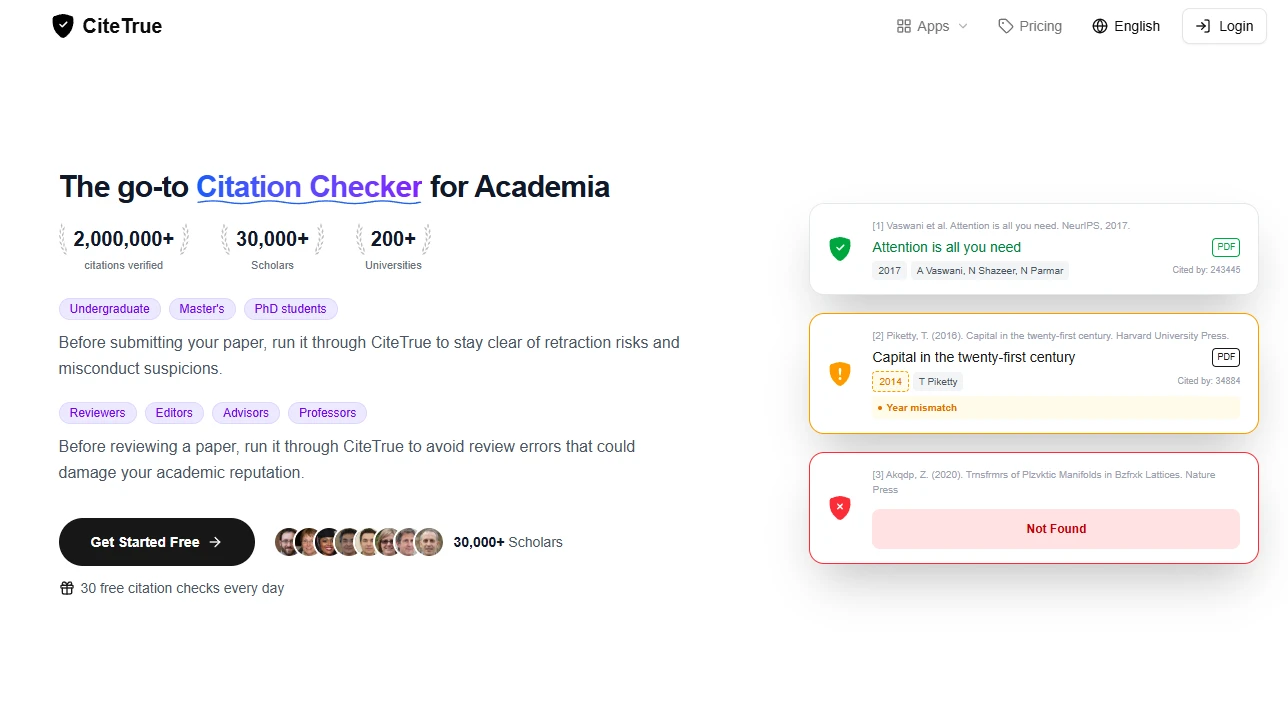
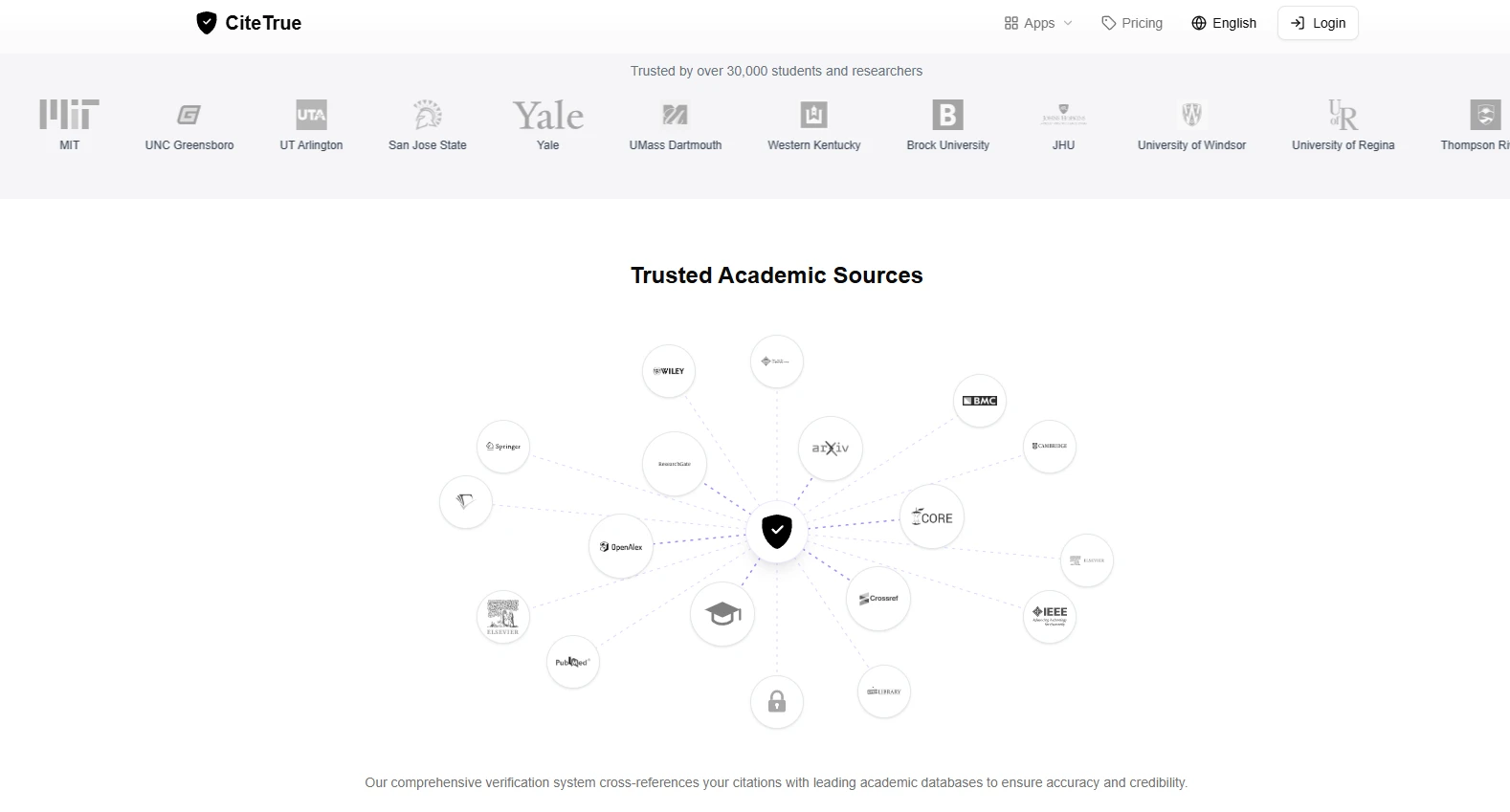
The system operates by taking your reference list and running it through a multi-stage verification process. It first parses the text to extract the key metadata, automatically correcting formatting errors in the process. It then sends queries to multiple authoritative academic databases simultaneously, including CrossRef, PubMed, and arXiv. The results are aggregated and analyzed using a proprietary scoring model that combines retrieval algorithms with language model analysis. The final output is a report that tells you, for each reference, whether it exists, whether the metadata is accurate, and how confident you can be in its authenticity.
The Efficiency Gain
The practical impact of this approach is significant. What would take hours of manual effort is reduced to seconds. The tool handles the tedious work of searching and cross-referencing, freeing you to focus on the higher-level tasks of analysis and argumentation. The efficiency gain is not just about time; it is about the quality of the work you produce when your cognitive resources are not depleted by monotonous verification tasks.
Testing the Tool in a Real-World Workflow
To understand the value of this tool, it helps to integrate it into a typical writing workflow and observe the results. The following scenarios illustrate how it performs in practice.
Scenario 1: The Pre-Submission Check
The most common use case is the final check before submission. I took a complete reference list from a manuscript and ran it through the system. The process was straightforward: copy, paste, and review. The report highlighted two issues. One reference had a year mismatch, and another had a minor author name error. Both were easy to fix. The peace of mind that came from knowing the rest of the list was clean was invaluable.
The Advantage of Batch Processing
The ability to check dozens of references at once is a major advantage. It turns a daunting task into a simple, one-click operation. This makes it practical to verify every reference in a manuscript, rather than just a random sample. The batch processing capability is what makes the tool scalable for large projects.
Scenario 2: The Literature Review Phase
Another valuable use case is during the literature review phase. When you are compiling sources for a new project, you can run your preliminary reference list through the tool to ensure the sources you are planning to cite actually exist. This can save time later by preventing you from building an argument on a foundation of non-existent sources.
The PDF Link Feature
A practical detail is that the report provides a direct PDF link for many references. This is a time-saver when you are trying to locate a source for further reading. It turns the verification report into a useful research tool in its own right.
Scenario 3: The Peer Review Process
For peer reviewers, the tool offers a way to quickly assess the quality of a manuscript’s references. I used it to check a paper I was reviewing. The process took less than a minute and revealed several issues with the reference list. This allowed me to provide specific, actionable feedback to the authors. It also gave me confidence that the other references were accurate, which is important when evaluating the overall credibility of the paper.
The Reviewer’s Perspective
The tool is particularly useful for reviewers because it shifts the burden of verification from a manual, time-consuming task to an automated, efficient process. It allows reviewers to focus on the substance of the paper while still ensuring the references are sound.
A Closer Look at the User Experience
The tool is designed to be as unobtrusive as possible. The interface is minimal, with a single input field and a button to start the verification. There is no need to create an account or install any software. This low-friction design is intentional. It makes the tool accessible to anyone, regardless of their technical expertise.
The Input Flexibility
The system accepts references in a wide variety of formats. This is a practical consideration because reference lists come in many shapes and sizes. Whether you are working with a numbered list, bullet points, or BibTeX, the tool handles it without complaint. The auto-correction feature is a thoughtful touch that reduces the need for manual cleanup.
The Output Clarity
The verification report is clear and easy to interpret. Each reference is listed with its confidence score and a summary of any issues found. The visual highlighting of problematic entries makes it easy to spot issues at a glance. The report also provides the corrected metadata, which can be copied directly into your reference list.
The Tool in Context: Strengths and Limitations
| Feature | CiteTrue | Manual Verification |
| Input Formats | Accepts multiple formats without reformatting | Requires manual entry or copy-pasting into a search engine |
| Verification Speed | Processes entire lists in seconds | Requires minutes per reference |
| Error Detection | Flags metadata mismatches automatically | Depends on the checker’s attention to detail |
| User Interface | Simple, single-page interface | Involves multiple tools and browser tabs |
| Confidence Scoring | Provides a quantifiable score for each reference | Relies on subjective judgment |
| Database Coverage | Cross-references multiple databases simultaneously | Limited to one database at a time |
The table highlights the clear advantages of the automated approach, but it also points to a limitation. The tool is dependent on the databases it queries. If a reference is from a source that is not well-indexed, the tool might not find it. This is a limitation of the current academic infrastructure, not of the tool itself. For the vast majority of standard academic references, however, the coverage is extensive and reliable.
Practical Limitations to Keep in Mind
While the tool is powerful, it is not a panacea. The quality of the output is directly tied to the quality of the input. If the original reference is so poorly formatted that the parser cannot extract the key metadata, the verification will be compromised. The system does its best to correct formatting, but garbage in will still yield questionable results.
Furthermore, the verification focuses on metadata accuracy. It confirms that a paper with that title, author, and year exists. It does not verify that the specific claim made in your text is actually supported by that paper. That level of content validation remains the responsibility of the author. The tool is a filter for existence and accuracy, not a substitute for reading and understanding the source material.
Finally, the system relies on the indexing of academic databases. A very recent publication or one from a less commonly indexed journal might not appear, leading to a false negative. In such cases, manual verification might still be necessary. The tool is best used as a first-pass filter, catching the obvious errors and freeing up your cognitive resources for deeper analysis.
Integrating the Tool into Your Writing Process
The most effective way to use this AI Citation Checker is to make it a regular part of your writing process, not a last-minute panic measure. Run a verification early in the drafting phase to catch errors when they are easy to fix. Run another check before submission for final peace of mind. The tool is quick enough that it can be used multiple times without disrupting your workflow.
The process is simple: copy your reference list, paste it into the tool, and review the report. The report can be exported for your records, which is useful for documenting your due diligence. The tool integrates seamlessly into your existing workflow, adding a layer of quality control without requiring you to change how you work.
In an academic environment where the pressure to publish is high and the tools for content generation are evolving rapidly, maintaining the integrity of the citation record is more important than ever. This verification system does not solve every problem, but it addresses a specific and growing vulnerability. It provides a practical, efficient way to ensure that the references you cite are real and accurate, allowing you to focus on the substance of your research with greater confidence and less anxiety.