
Online reviews become useful when a reader can connect a comment to an action. “Great service” says little. “The team fixed a broken link” points to a repair step that another buyer can ask about. This is a practical way to judge a Guest Post provider without pretending that praise, star counts, or one dramatic complaint can predict your own result.
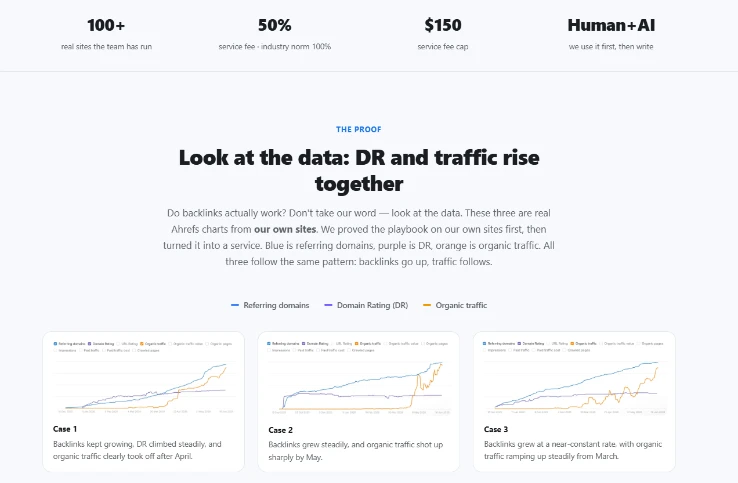
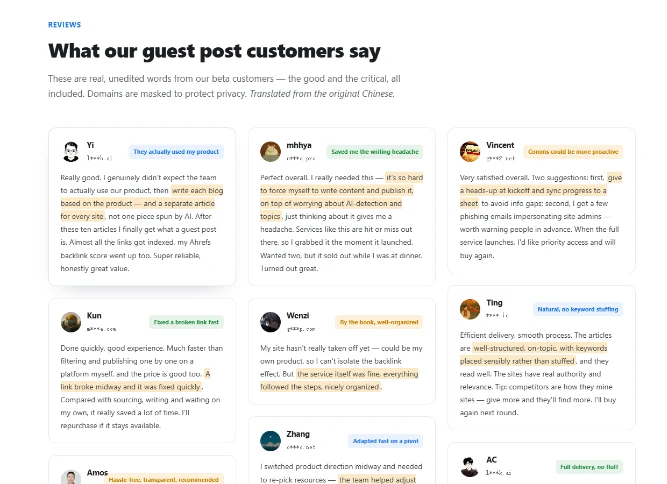
The current BestLinks AI page publishes ten beta-customer reviews, including praise and criticism. It explains that thirteen customers bought during the early beta: two saved the service for later, one received a refund because the need was non-English, and ten used it. That accounting gives readers more context than a row of perfect scores. It also creates a small lesson in digital literacy: read for repeatable behavior, stated boundaries, and work the buyer still owns.
Turn Each Review Into A Testable Claim
A testimonial mixes emotion, outcome, and interpretation. Separate them. A buyer may say the process felt smooth, the links were indexed, and the service offered good value. “Smooth” is a feeling. “Links were indexed” is an observed status for that buyer. “Good value” depends on the buyer’s budget and the hours saved.
Write one claim beside each sentence. Then ask what another customer could inspect. A shared sheet can be inspected. A separate article for each host can be inspected. A repair note can be inspected. A promise that the service will raise every site’s traffic cannot be inspected before purchase and does not appear as a guarantee on the service page.
- Underline the action the team took.
- Circle the result the customer could observe.
- Mark any judgment that depends on price, timing, or personal taste.
- Write one follow-up question for the buyer’s own campaign.
This method stops attractive adjectives from doing the whole job. It also gives critical comments a fair place. A complaint can reveal a missing warning or unclear handoff without proving that every other step failed.
Separate Feelings From Visible Campaign States
Campaign states use nouns and verbs a team can verify: shortlist delivered, host approved, draft revised, article published, link repaired, URL marked in GSC. Feelings such as easy, professional, and frustrating still matter because services sell time and attention. Keep them in a separate column so a strong feeling does not replace the event behind it.
Positive Reviews Should Reveal Repeated Work
Several published comments describe the same broad value from different angles. Customers mention that the team used their product, wrote separate articles, saved sourcing and writing effort, kept results visible in a shared sheet, fixed a broken link, and placed keywords naturally. The repeated pattern is managed labor with a visible trail, not a mysterious ranking shortcut.
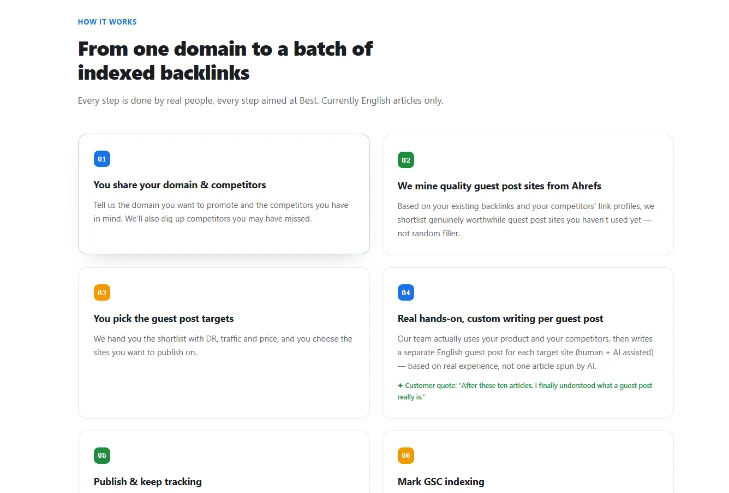
That pattern matches the official workflow. The buyer supplies a domain and competitors. The team mines hosts from backlink neighborhoods in Ahrefs, the buyer chooses from DR, traffic, and price data, humans use the product before writing, and publication happens one site at a time. Monitoring continues after the page goes live, while the client marks indexing.
A useful review confirms one of those steps with a concrete consequence. The broken-link comment supports the existence of repair work. The shared-sheet comment supports transparency. The natural-keyword comment supports editorial care. None of them can prove a future ranking position, but together they help a buyer decide which workflow questions deserve attention.
Count Independent Behaviors Not Repeated Praise
Five reviewers can call a service “great” and still provide one piece of information. Three reviewers can describe product use, repair speed, and status tracking and provide three different behaviors. Count the behaviors. This keeps a loud review section from looking stronger than a smaller section with detailed, varied evidence.
Critical Reviews Expose The Missing Handoff
One beta reviewer asked for more proactive kickoff and progress updates. The same reviewer reported phishing emails that impersonated site administrators and suggested warning customers earlier. That comment does not erase the positive delivery. It identifies two handoffs a buyer should make explicit: where official campaign updates appear and how the team verifies unexpected publisher messages.
Another review says a product direction changed and the team helped pick resources again. The positive outcome matters, but the underlying question is stronger: what happens to competitors, host choices, drafts, and target pages when the product changes mid-campaign? A prospective buyer can ask that before a pivot forces an afternoon of rework.
Critical detail often produces the best buying question because it points to a failure that already occurred. The visible result is not “the service is bad.” It is a specific control the next campaign can add. Discard a review only when it offers no event, no action, and no way to test its claim.
Convert One Complaint Into One Control
Turn “communication could be more proactive” into a progress-update owner and cadence. Turn “phishing emails arrived” into a verified-channel rule for money, credentials, and new files. Turn “the product changed” into a change ticket that freezes unpublished rows. The control should answer the complaint without building a bureaucracy around every message.
Check Review Claims Against Published Mechanisms
Reviews gain weight when the service description contains the mechanism that could produce the reported outcome. A customer says sourcing time fell; the page describes competitor-led site mining and a shortlist with metrics and price. A customer says a broken link was fixed; the page says monitoring and repair continue after publishing. A customer says the content was not mass-spun; the page describes human-led, AI-assisted writing after product use, with a separate English article for every host.
The check works in both directions. If a review praises a feature the current page does not describe, ask whether the feature was a one-time favor, a beta experiment, or an outdated process. Do not promote it into a standard promise. Product pages change, and a review records one customer’s moment.
A mid-body review of BestLinks AI should also preserve the service boundaries. The current offer is English-only. It targets sites already making money and tells early projects to focus on free backlinks and product validation first. A positive testimonial from an established site does not remove those filters for a new local-language project.
BestLinks AI also separates placement cost from its service fee: fifty percent of placement, with a fifteen-dollar minimum and a one-hundred-fifty-dollar cap per article. A review that says “good value” becomes more useful after the reader compares that formula with the work described and the hours their own team would otherwise spend.
Build A Small Claim To Workflow Worksheet
A classroom or team exercise needs only four columns: review sentence, reported behavior, published mechanism, and buyer question. Give two people the same three reviews. Their opinions may differ, but their extracted actions should be close. If one person finds “fixed a broken link” and the other finds only “excellent support,” return to the wording and choose the more observable note.
Use the worksheet on one positive, one mixed, and one critical review. Keep the test protocol simple: the reader must name the event and point to the mechanism that could repeat it. A claim the reader could not defend from the published process goes into a separate unverified box. If no action or mechanism remains after the adjectives are removed, mark the claim rejected for procurement use rather than stretching it into proof.
A sample set of buyer questions might include:
- Where will every host, draft, live URL, and index mark be recorded?
- Who confirms unexpected emails or payment changes?
- What happens when a target page or product direction changes?
- How does the team document a broken-link repair?
- Which product facts must the client approve before publication?
The questions are more valuable than a summary score because they change kickoff behavior. A score sits in a deck. A clear owner and status field prevent lost time when a real campaign reaches the same handoff.
Good Review Reading Ends With Better Questions
The published review set gives readers enough mixed beta material to practice careful judgment: ten users, specific praise, a refund tied to the English-only boundary, an adjustment after a product pivot, a repaired link, transparency comments, and a request for stronger communication warnings. BestLinks AI does not need every review to agree for those details to expose how work moves.
Choose the service if those mechanisms match a mature site’s needs and your team will still approve hosts, product facts, and GSC marks. Wait if the site has not proved demand, needs non-English production, or expects reviews to guarantee traffic. The page itself draws those boundaries.
Read the next review with one habit: replace each adjective with an action you can verify. If no action remains, the sentence is sentiment. If a repair, handoff, approval, or visible status remains, you have a question worth carrying into the campaign.