
There is no meaningful universal price for a custom AI dataset. Two projects with the same number of records can have very different costs because sourcing difficulty, capture conditions, annotation complexity, quality assurance, rights review and ongoing maintenance can be completely different. This is why providers generally scope custom projects around a brief rather than a fixed price list.
For example, Wavebreak Media’s custom dataset production can involve different combinations of existing licensed media, curation, new production, metadata, annotation and delivery depending on the requirement. The same principle applies across the market: cost depends on what has to be produced and what the buyer expects to receive.
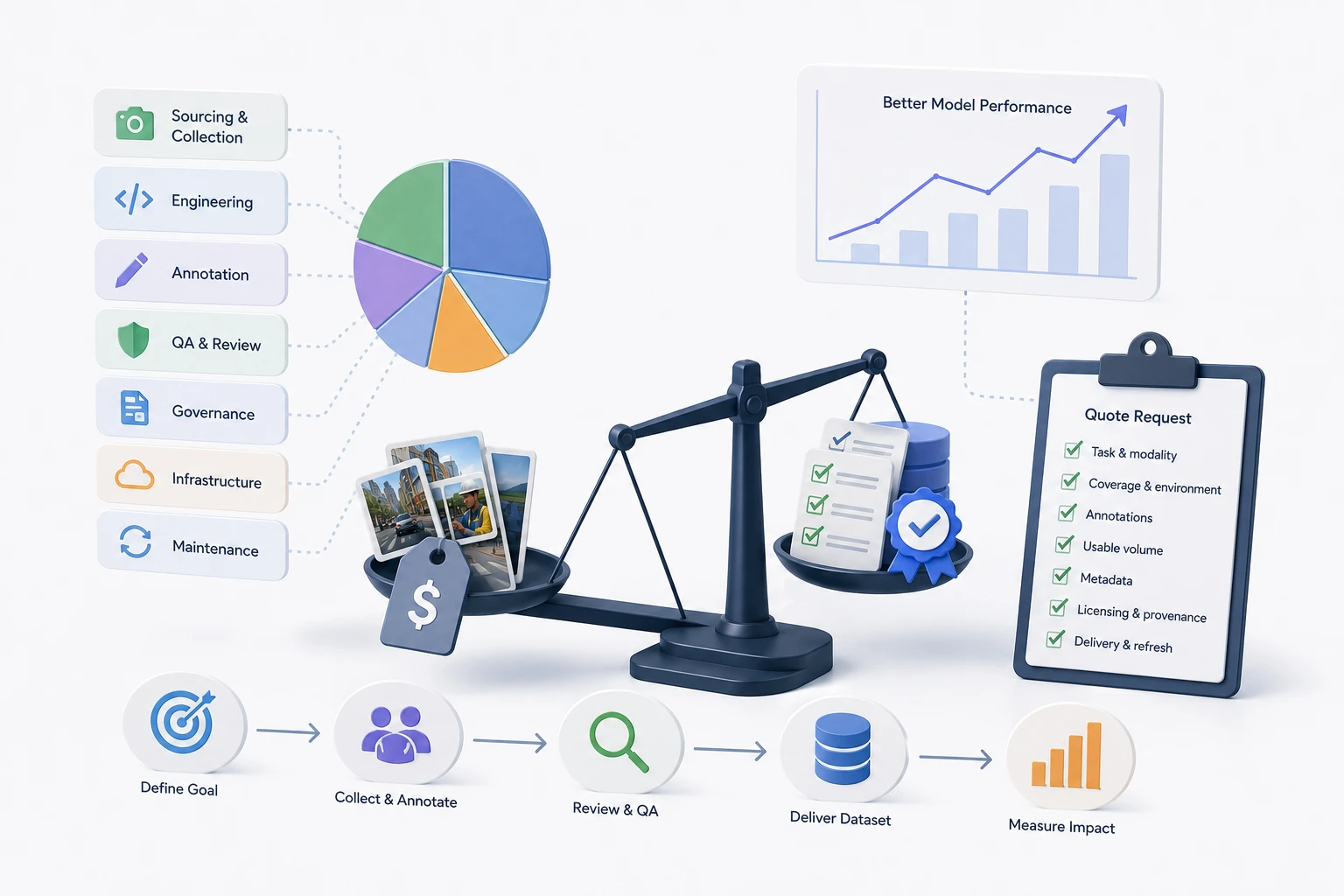
What actually contributes to custom dataset cost?
| Cost area | What it can include |
|---|---|
| Sourcing and collection | Existing media, new production, contributors, locations and specialist capture |
| Engineering | Preprocessing, normalization, transformation, deduplication and pipeline work |
| Annotation | Labels, boxes, masks, temporal events, transcripts or structured metadata |
| QA and expert review | Sampling, secondary review, adjudication and rework |
| Governance | Provenance, privacy controls, licensing review and documentation |
| Infrastructure | Storage, tooling, secure transfer and dataset management |
| Maintenance | Refresh collection, relabeling, drift analysis and version updates |
Why price per record can be misleading
Consider two providers. The first quotes a lower price per record, but a significant share of the delivery fails QA, important metadata is missing and engineers need to clean the data manually. The second charges more per record but delivers material that reaches the model-development pipeline with much less remediation.
The first option looks cheaper only while the denominator is raw records.
A more useful internal measure is:
total production and preparation cost ÷ accepted, model-useful records
This is not a formal industry standard. It is simply a more useful procurement calculation than comparing raw unit prices.
Dataset size is not the same as dataset value
A large batch of routine examples may add almost no performance once the common distribution is already well represented. A much smaller set of difficult edge cases can sometimes reduce a costly production failure.
This is why dataset spending should connect to evaluation. A dedicated model evaluation dataset can help establish the baseline and show where additional collection is actually worth funding.
What tends to make a custom dataset more expensive?
- rare or difficult-to-source subjects;
- controlled environments or specialized equipment;
- exact geographic or demographic requirements;
- multiple capture conditions or viewpoints;
- domain-expert annotation;
- asset-level provenance or participant documentation;
- strict privacy or access controls;
- complex metadata requirements; and
- frequent refresh or replenishment.
These requirements are not necessarily unnecessary overhead. If they are essential for deployment, removing them from the initial quote simply moves the cost to a later stage.
Maintenance belongs in the budget
Custom datasets age. Production environments change, new products appear, terminology moves, labels evolve and new failure modes emerge.
Potential recurring costs include:
- new data collection;
- drift monitoring;
- relabeling;
- documentation updates;
- quality re-audits; and
- compatibility testing with new model versions.
Connect spending to a business outcome
Custom data creates economic value when better model behaviour changes a decision that is frequent, costly, risky, revenue-generating or strategically important.
Depending on the application, that may mean fewer false positives, fewer missed defects, less manual review, faster case resolution, better retrieval or safer model behaviour.
A useful ROI discussion answers three questions:
- What decision does the new dataset improve?
- How often does that decision occur?
- What is the economic difference between a better and worse decision?
If those questions cannot be answered, the dataset initiative may still be under-specified.
What should go into a quote request?
Provide enough detail for different suppliers to price the same problem:
- model task and modality;
- target environments and coverage;
- annotation requirements;
- expected usable volume;
- metadata fields;
- licensing and provenance requirements;
- delivery structure; and
- expected refresh frequency.
Frequently asked questions
How much does custom AI dataset production cost?
There is no universal rate. Cost depends on sourcing, modality, collection difficulty, annotation depth, expert review, QA, governance, engineering and maintenance.
What is the best way to compare custom dataset prices?
Compare the total cost of obtaining accepted and usable data rather than only the provider’s raw price per record.
Are custom datasets always more expensive than existing datasets?
They usually require more setup, but an existing collection can also become expensive when substantial filtering, relabeling or remediation is required.
Conclusion
A cheap dataset is not necessarily cheap to use. The more useful calculation includes the work required to turn production output into approved data that improves model behaviour and remains usable over time.