
Every songwriter knows the weight of a half-filled notebook. Verses that do not find their chorus, lyrical fragments that lack a musical home, melodic ideas trapped in voice memos because arranging them into a full production demands time, collaborators, or skills that a lyricist may not possess. The emergence of tools that can take raw text and return a fully produced song is shifting something fundamental about the songwriting process — not by replacing the writer, but by collapsing the distance between an idea and a listenable draft. I spent focused time testing how well an AI Music Generator handles the messy, non-linear reality of songwriting, paying attention to what happens when unfinished lyrics, rough structural notes, and half-formed concepts meet an AI trained to complete them.
The Creative Friction That Slows Down Songwriters
The gap between having lyrics on paper and hearing them as a song is, for most writers, the hardest mile. Traditional workflows require finding a producer, booking studio time, communicating arrangement ideas, and waiting through revisions — a cycle that can stretch for weeks or months. Even for writers who produce their own music, the technical overhead of building a full arrangement can interrupt creative flow. The promise of an AI co-writer is not about eliminating effort but about shortening the feedback loop between writing a line and hearing it sung back with full instrumentation, so the creative momentum does not stall while logistics get sorted.
Why Speed of Feedback Matters More Than Perfection
In my songwriting sessions, I noticed that the emotional energy behind an idea tends to decay the longer it sits unrealized. A lyric that felt urgent on Tuesday can feel distant by Friday if no musical context has materialized. The ability to feed that Tuesday lyric into a system and hear it returned as a complete track within minutes — even an imperfect one — preserves the creative spark in a way that traditional demo production often cannot. The question I set out to answer was whether the AI’s interpretation would enhance the original intent or flatten it into something algorithmically competent but emotionally generic.
How the Platform Transforms Text Into Structured Songs
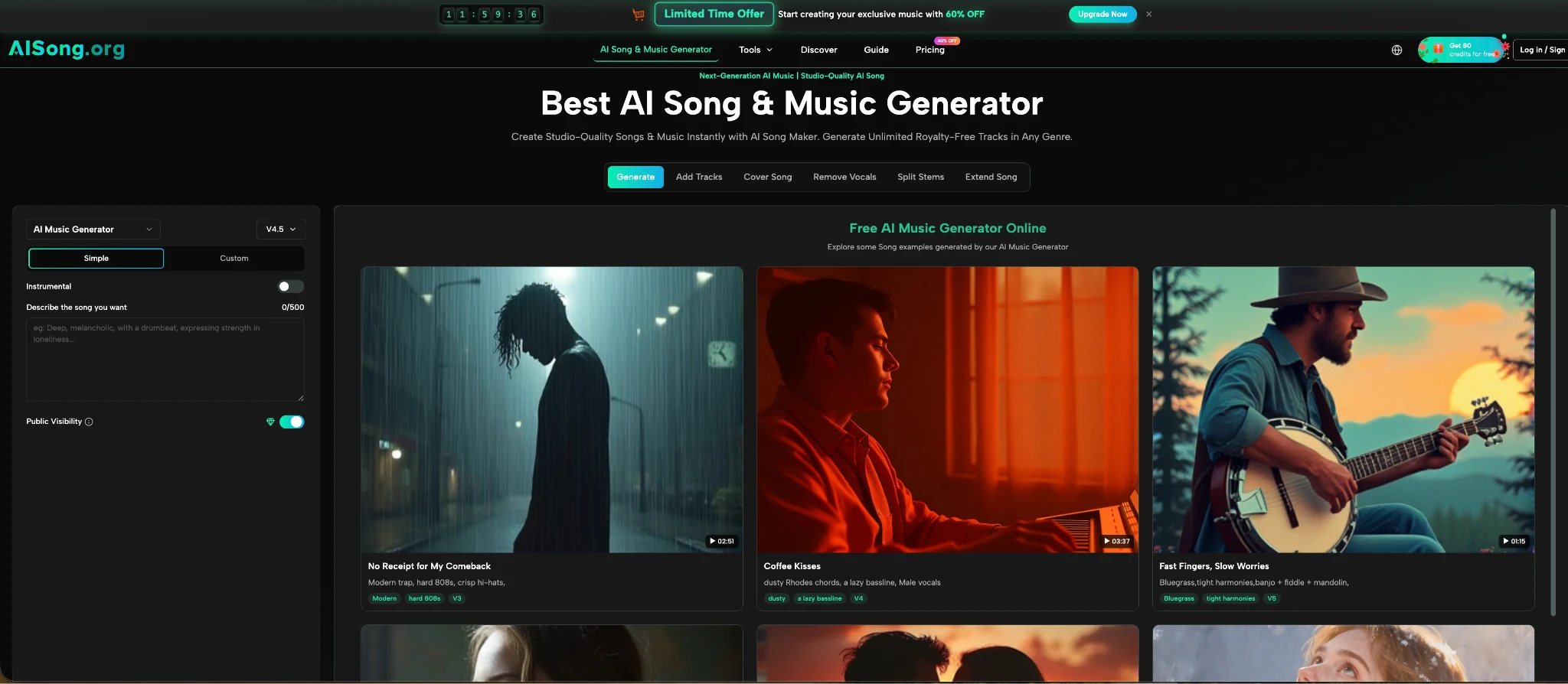
The AISong platform handles lyric-to-song conversion through a Custom Mode that accepts user-provided text, style descriptions, and optional structural markers. The workflow is intentionally linear, which helps when you are moving between creative ideation and technical execution.
Step One — Enter Your Lyrics and Define the Musical Framework
The input screen presents fields for song title, lyrics, and style description. You can paste finished lyrics, or you can type them directly. The platform also offers an AI Lyrics Generator for moments when you have a theme but no words yet. In my testing, I used both approaches: once with a complete set of lyrics I had written months ago but never recorded, and once with only a thematic concept that I asked the AI to develop into full lyrics. The style description field accepts natural language — for my completed lyrics, I specified “indie folk with fingerpicked acoustic guitar, gentle male vocals, and a bittersweet emotional tone.”
How Structural Markers Influence the Arrangement
The lyric input field optionally supports section labels like Verse, Chorus, and Bridge. When I marked my lyrics with these cues, the AI responded with clear dynamic shifts between sections. The chorus opened up sonically with fuller instrumentation and wider stereo imaging, while verses pulled back to sparser arrangements. A test run without any section markers produced a song that still worked musically but lacked the same clear structural dynamics — it felt more like a continuous block of music than a crafted song with intentional rises and falls. For songwriters who think in terms of song structure, taking the extra minute to label sections pays off in the final output.
Step Two — Choose a Model and Let the AI Complete the Production
Once the lyrics and style are submitted, the platform processes the input through one of several AI model versions. Each model has its own characteristics in terms of output style and generation speed. In my testing, I experimented with multiple models on the same set of lyrics to compare results. The generation process starts delivering audio relatively quickly, and the complete song appears in the user’s cloud library automatically. There is no need to manage local files or worry about losing earlier versions when generating multiple takes of the same song.
What the AI Decides Without Your Input
Listening analytically to the output, it became clear that the AI was making a range of production decisions independently: tempo, key, chord progression, instrumentation density, vocal processing, and overall mix balance. With a folk-leaning prompt, it chose acoustic guitar, soft percussion, and a warm vocal treatment. When I switched the style to “synth-pop,” it applied electronic drums, layered synthesizers, and more present vocal reverb. These invisible decisions are the difference between a tool that requires production knowledge and one that allows a pure lyricist to hear their words in a finished context without ever touching a fader. The trade-off is that you cannot easily adjust those decisions after the fact — you accept the AI’s production choices or re-generate with a revised prompt.
Step Three — Listen, Compare Versions, and Export
After generation, the completed song is playable directly from the library. The interface keeps all previous generations accessible, which is particularly useful for songwriters comparing different style interpretations of the same lyrics. I generated a folk version, an indie rock version, and a stripped-down acoustic version of the same set of lyrics and A/B tested them within minutes. When I found a version that resonated, I downloaded it as an MP3. Paid plans provide private storage and commercial usage rights, which matters for writers who want to share drafts with collaborators without making them publicly visible.
Using the AI Lyrics Generator as a Starting Point
For the session where I started with only a theme — “nostalgia for a hometown that no longer feels like home” — I used the AI Lyrics Generator to produce multiple lyric drafts. The output arrived in structured verse-chorus format within seconds. The first draft leaned on broad emotional statements; a second attempt with the same theme produced more concrete imagery involving specific streets, seasons, and objects. Neither version was publication-ready, but both provided a scaffold that I could edit, rearrange, and personalize. The value was less in receiving a final lyric and more in breaking the intimidation of the blank page with something I could react to and improve.
Testing the AI as a Collaborative Songwriting Partner
A useful creative tool should adapt to different working styles. I tested the AI Song Generator across three songwriting scenarios that reflect how real writers work, from the lyricist who has words but no music to the producer who needs a quick reference track.
Scenario One — The Lyricist with Finished Words and No Melody
I input a complete set of lyrics about a coastal road trip, marked with section cues, and described “upbeat acoustic pop with harmonies and a driving rhythm.” The AI returned a song with a catchy chorus melody that I genuinely would not have written on my own — it took a melodic leap in the hook that felt surprising and effective. The verse melody was more predictable, settling into a comfortable range that served the lyrics without drawing attention to itself. The vocal delivery sounded competent, though on a quieter, more intimate passage the emotional nuance felt slightly generalized rather than deeply felt.
Scenario Two — The Producer Who Needs a Fast Reference Track
For a producer who wants to communicate an arrangement idea to session musicians or a band, generating a full production from a prompt offers a speed advantage that written notes or verbal descriptions cannot match. I described “a moody, slow-building track with verse, pre-chorus, and an explosive chorus, with layered backing vocals and a guitar solo bridge,” and within minutes had a reference that demonstrated the structure clearly. The AI Song Generator handled the dynamic arc effectively, though the guitar solo was more functional than inspired — it fit the key and tempo but lacked the improvisational feel of a human player. As a communication tool for structural ideas, the output was excellent. As a final recorded part, it would likely need replacement.
Scenario Three — The Stuck Writer Seeking Unexpected Directions
I fed the AI a short lyrical fragment that had been sitting in my notes for months: two lines about a conversation in a late-night diner, with no clear sense of what the song should sound like. I intentionally did not specify a genre and let the platform choose. The result arrived as a slow, atmospheric track with minimal percussion and a spacious vocal delivery — a direction I had not considered but that opened up new possibilities for the rest of the song. This ability to surprise, to offer a musical context that the writer would not have chosen independently, may be the most underappreciated aspect of AI songwriting tools. It functions less as a replacement for taste and more as a source of controlled randomness that can jolt a project out of familiar patterns.
AI-Assisted Songwriting Versus Traditional Demo Production
For songwriters evaluating whether AI generation fits their process, a direct comparison against conventional demo workflows helps clarify where the technology adds value and where it still falls short.
| Production Dimension | AI Song Generation (AISong) | Traditional Demo Production |
| Speed from Idea to Audible Draft | Minutes | Days to weeks |
| Upfront Cost | Subscription-based, predictable | Session musicians, studio time, or producer fees |
| Arrangement Control | AI interprets style descriptions; limited post-generation adjustment | Full control over every instrument and performance |
| Vocal Authenticity | AI-generated vocals; technically accurate, emotionally variable | Human vocalist with interpretive nuance |
| Revisability | Re-generate with new prompts; no individual track editing | Full multitrack access for mixing and editing |
| Ownership and Rights | Commercial license included on paid plans | Standard work-for-hire or royalty agreements |
Where the AI Hits Its Creative Limits
Realistic expectations are essential for songwriters considering this tool as part of their process. The following limitations emerged consistently during my testing.
Interpretive Depth in Lyrical Performance. The AI delivers words clearly and in tune, but it does not live inside the emotional experience those words describe. A line about grief sounds appropriately somber, but it lacks the micro-inflections — the slight catch in the throat, the deliberate hesitation — that a human vocalist might bring to the same material. For demo purposes, the difference is acceptable. For a final release, it may not satisfy listeners attuned to vocal authenticity.
Structural Predictability Across Generations. The AI tends to default to familiar song structures — verse-chorus-verse-chorus-bridge-chorus — which is musically sound but can feel formulaic if you are seeking unconventional forms. Pushing the system toward atypical structures with prompts like “no repeating chorus” or “through-composed” produced mixed results in my testing; sometimes it followed the instruction, and sometimes it reverted to standard patterns.
The Prompt-Learning Curve for Precise Results. Getting exactly what you hear in your head requires developing a working vocabulary for describing music in text. Songwriters who are new to articulating production choices — reverb type, compression character, stereo width — may find the initial results inconsistent until they build that descriptive skill. The tool rewards specificity, but it does not teach it.
The Mix Is Final. Without stem export capability, the stereo mix that the AI delivers is the only version you get. If the vocal is slightly too loud in the chorus or the bass lacks definition, you cannot adjust those elements independently. For demo purposes, this is rarely a problem. For anyone intending to release the track commercially without additional production, it is a meaningful constraint that should factor into the decision.
The role of AI in songwriting is still being defined, but after weeks of hands-on testing, one thing is increasingly clear: the technology works best not as a songwriter replacement but as a creative accelerator. It shortens the distance between an idea and an audible, shareable form, which for many writers is the entire point. The songs that result may not be the final versions that go out into the world, but they give the writer something that the notebook alone cannot — a reason to keep writing, and a clearer picture of where the song wants to go.